
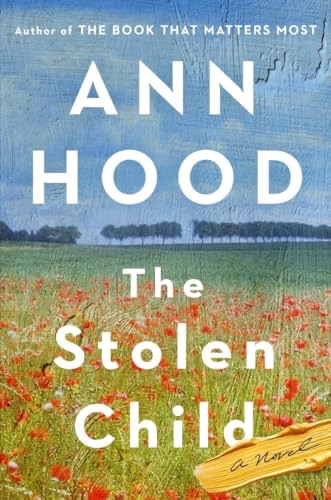
You should know before reading this that I am both an admirer of Ann Hood both as a writer and as the person she seems to be. I met her many years ago when I was freelancing as a reviewer and author interviewer. She was on a book tour for her 2006 novel, The Knitting Circle. I had been to many book readings but never one like this.
It was held at an independent book store, The Book House. Women carrying their knitting bags and books were wound down and around the aisles anxious to meet Ms. Hood.
She made her remarks and then listened with patience and heart to every story told to her. Stories of tragedy and knitting and whatever had happened to connect them to this story of a young mother grieving the loss of her child and finding community and solace through a knitting group. I was astounded by her patience and empathy. I’m sure she experienced this repeatedly as this book tour went on.
Years later, she became an increasingly successful author and I met her at several book festivals. She was the same Ann Hood. Warm. Gracious. Openhearted.
I’ve read many of her books since. Some engaging, others not so much but when I read this latest book, The Stolen Child, I was immediately absorbed in this beautiful story of regret, forgiveness, and the pursuit of dreams.
The novel has three main characters crossing three different time periods.
Nick Burns is a WWI veteran. As common during this war, soldiers spent a great deal of time waiting in trenches for the Germans to attack. While I knew that, I was unaware that to pass the time or distract themselves, soldiers used that time to scratch, paint, or draw murals on the trench walls. (Learning something new from the past is another benefit of reading historical fiction).
“What Nick had with him was a small tin of paints and a brush. He spent endless hours painting on the stone wall… A mural of the Charles River on a summer day, people strolling along its banks, a band playing, a crew team rowing past. He gave all the figures the faces of his family and friends back home…Nick Burns was painting his world, right here in a stinking trench on a farm near a village in France.“
Nick was working on his mural when a young farm girl/artist, Camille, gives him some of her very small (canvas was precious) but brilliantly colored paintings and later, her baby to keep safe. Nick doesn’t know what to do and leaves the baby near a well in town hoping someone will find and care for him. Regretting this decision impacts the rest of his life.
In his seventies, having been diagnosed with terminal cancer, he decides to go back to Europe to find out what happened.
In 1970s Rhode Island, Jenny, is a college student. She has great plans for her future but makes a mistake that derails the trajectory she was on. Working as a waitress at an IHOP, she saves everything she can to get her to Europe. This dream remained alive and well and she wasn’t about to let it go.
Jenny saved her tips, the quarters and dimes that jingled in her pink polyester apron pocket. If she took a plane to Iceland, she could connect to a flight in Rome, then take a train from Rome to anywhere—Florence, Naples, Milan. This, she learned from a bored travel agent …was the cheapest way to get to Europe.
When she sees Nick’s ad for someone to help him on his quest, she is all in.
In Naples, two brothers own a shop making nativity scenes. The one brother, Enzo, is very sensitive to the pain and suffering of people he casually meets. And he is a romantic. He begins to collect the tears in glass tubes. He notes who and why people are crying. Over the many years, he collects enough tears to set up the Museum of Tears at the back of nativity shop.
Standing here in the shop with Geraldine Walsh walking toward him like a beam of sunshine, with faint lingering smells of the gas from the stove and coffee filling his nose, Enzo felt younger, eager, ready. Ready for what he did not know… Just three days earlier it had seemed to Enzo that the world was ending. The torrential, relentless rain. The sewers bursting and the roads collapsing. But today, just three days later, it seemed to him that. the world was, in fact, just beginning.
Many colorful characters wind their way in and out of the story. Nick’s wife, Enzo’s brother, potential love interests for Jenny and the romantic, Neruda lover, Daniel, Jenny’s stifling mother, Geraldine, the Irish reporter who is fascinated by Enzo. They don’t overwhelm and there is just enough to give the story texture.
The settings were vivid. I wanted to eat all the food (except one meal!). Although it took me some time to adjust to the different stories, I wanted a satisfying ending and wasn’t disappointed. It may not have been surprising but it was just right.
The biggest negative was the title. The book was so much more than that and there are too many books with that title.
Recommend.

Ann Hood has written twelve books—novels, essay collections and short fiction. For more information about her, please visit annhood.us.
 Reader’s Cafe