
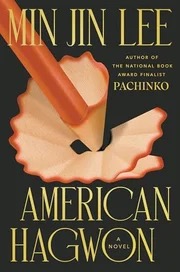
I loved the first two books in Min Jin Lee’s quartet and this third one is no exception. From what I’ve gleaned from her interviews, this question that drove this story was how does the extreme pressure for specific academic success intersect with real love of learning and overall life satisfaction? Her research is wide, but her focus is narrow. As she states in an interview on Fresh Air, “I think education is a beautiful thing. But I think we now really have to ask why do we get it and what do we want from it?”
I found the idea interesting and extremely relatable. As a third generation Jewish woman, going back to my grandparents’ entry into America in the early 1900s, my family also subscribed to the idea that education was the only path forward. It was an overarching expectation. There was never a question that anyone of us would not work hard to get into the best colleges. It was key to success in life.
In this story, Lee creates a world populated by characters who are part of the Korean diaspora. They are all strivers, each in their own way working toward what is viewed as a successful life the entire family can be proud of. The the reader is given a lens into all the layers we must travel through on the way to achieving what we’ve been told is success.
For those who are not familiar with what a hagwon is ( I had never heard the word before), they are schools that are outside of regular schools. While they prepare older students for standardized tests and other aspects of college admission to top universities, children begin attending when they are elementary level. There is competition to attend the best hagwons. Some are cram schools, others have specialties.
The story here focuses on two fictional hagwons in Southern California that seeks to educate and nourish their students not only in academic success but in their pursuit of a happy life.
The cast of characters is well rounded. The story centers around the Koh family—parents Helen and John, sons Bo and DH, daughter Mido. John is a successful administrator who has lived in the US, Australia, and Korea. His children were born in New Jersey.
He is faced with a difficult problem at work. His best friend and boss, Shin, is having an affair with one of their employees, an unscrupulous woman, who has begun to cloud Shin’s reality. John is forced by Shin to do something against his better judgement which sets in motion upheaval for the Koh family. This is compounded by the Asian financial crisis (1997). Their economic struggle results in a lasting and severe changes in the family’s standard of living.
The very quiet young Mido has made a friend in gregarious schoolmate, Yun. This friendship which will have an impact on the trajectory of her life and family but Yun’s family also is tangled in financial woes and must leave Korea for Southern California. Before long, the Kohs move as well. But, first they go to a job John finds in Australia. Eldest son, Bo, stays behind determined to get into a prestigious Korean University that bases its admission on a single test. DH, an outgoing athlete, has had the good fortune to attend Andover,Yale, and then Columbia Law school.
When the Kohs move to Southern California from Australia, their lives become entwined with members of the community they left behind in Seoul. Yun marries Lion, owner of two hagwons, who is trying to instill the goal of academic excellence with love of learning. Bo, DH, Mido, and DH’s longtime friend, supporter, and schoolmate, Peter, all eventually work at these hagwons. John cannot find a suitable job and goes to work with Yun’s mother. Helen also finds employment, but less than what she is qualified for. The once quiet Mido finds herself working at the Hagwon, seeing no rush to get her degree as she supports her brothers’ educations.
All the stories become intertwined in the most interesting ways. The characters were well defined. The sense of family duty is remarkable. I cannot imagine an American born child deferring college to put their older siblings through. The storylines contrasting generosity and devotion with greed, sexism, racism was so believable. I could feel the wind of the changing fortunes as they were happening.
I will long remember the Koh family. Each character delineated so well. Sonya, Helen’s sister was remarkable.Strong and directed yet vulnerable. Lion, Peter, Yun’s and Peter’s mother, all fascinating. I understood the purpose of Danbi, Shin’s lover, in the trajectory of the story but after a while I got the point and felt it was too much of her and her tedious seductions. My one small complaint.

Min Jin Lee is the author of the novels Free Food for Millionaires and Pachinko, a finalist for the National Book Award. She was runner-up for the Dayton Literary Peace Prize, and listed in the New York Times “100 Best Books of the Century.” She is the New York State Author Laureate (2025-2027),
Lee’s received many literary prizes. These include: the Edith Wharton Citation of Merit; The Fitzgerald Prize for Literary Excellence; the Manhae Grand Prize for Literature, the Bucheon Diaspora Literary Award, and the Samsung Happiness for Tomorrow Award for Creativity from South Korea. She is also the recipient of fellowships in Fiction from the Guggenheim Foundation, the Harvard Radcliffe Institute, and the New York Foundation for the Arts. She is an inductee of the New York Foundation for the Arts Hall of Fame and the New York State Writers Hall of Fame.


Novels:
We’ve Come Undone
Standing on the Corner of Lost and Found
Poetry:
The Me I Was With You
Paternal Nocturne
Floating Islands
Woman Sitting in a Cafe and Other Poems of

